It is likely that the Old Oak Inn started life as the Royal Oak, a common English pub name that was adopted with the restoration of the monarchy after the English Civil War. Following the execution of Charles I, his son, also Charles famously hid from the Roundheads in an oak tree before fleeing to France. On his return as King in 1660, many pubs were renamed the Royal Oak in his honour.
There may have been an Inn on the site from the late 17th Century, although it is believed that the current building was constructed in 1733 at a cost of £300, initially as an almshouse or poor house for four families, hence why there are four fire places in the building. At some point it was designated the Parish workhouse. These were common prior to the Poor Law Amendment Act 1834, which saw the establishment of larger Union workhouses.
The earliest OS Map of 1878 shows the building once again as a pub called the Royal Oak. The fourth building nearest the car park was initially used as an ale and cider house for the workers in the local agricultural, brick making and charcoal burning industries.
The census of 1881 records the inhabitant of what was by then the Old Oak to be Peter Lambert, a woodreve and innkeeper born in Arlington and who resided here with his wife Elizabeth, their seven children and another male relative who worked as a labourer.
The stable at the rear of the pub is likely to have been built sometime between 1878 and 1898 and a further building was added to what is now the car park, sometime between 1910 and 1928. Photographs show this being used as a separate tea room.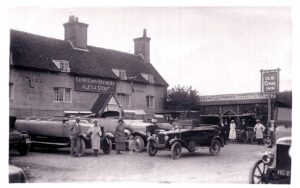
The Old Oak is a Grade II listed building and a significant example of an early 18th Century coaching inn. The facade of the pub is classic of Georgian design demonstrating their penchant for “polite” symmetrical facades and ordered fenestration.
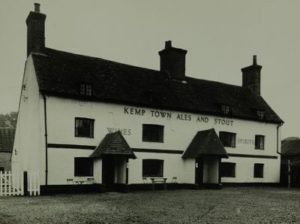
This photo was taken by the Charrington Brewery during an architectural survey of their pubs.
Embedded beneath the bar are four ornate wood carvings depictng the Inn from four different eras, showing agricultural workers, archers, a dovecote and what appear to be first world war tanks outside the pub. It is understood that a local carpenter was commissioned to do the engravings as part of his apprenticeship.
Things that go bump in the night….
Rumours abound of the pub being stalked by the ghost of a former landlady. Mrs Julia Alice Turner, aged 69 lived at the Inn with her son and daughter in law, who had taken over the running of the pub from her. One Wednesday evening after the pub had closed, Julia sat with her son and his wife in front of the fire until midnight. John, her son and Alice, his wife, had decided to turn in, leaving Julia downstairs. They recalled the fire had burnt low by this point.
At around 1.45am they were woken by the dog barking and what sounded like someone knocking on wood. They ran downstairs to find Julia in the bar near the counter standing with the majority of her clothes burnt off. Sadly she did not survive. The cause of the fire was unexplained. The chair that she had been sitting in was not burnt at all but there was a circular scorch mark on the wooden flooring. Previous occupiers report trying to sand down the marks only for them to reappear some time later. Others report strange sightings of Julia and mischievous goings on when the customers have left.